GradskillsPro
The best way to start writing your manuscript TODAY

~ How to write a paper using the IDEAS framework – post 3 of 6 ~
Posted on MM/DD/YYYY
Click here for part 1 / 2 / 3 / 4 / 5 / 6
Download the step-by-step process of the IDEAS framework HERE
So, you’ve procrastinated to the point of no return. Or you are one of the lucky ones who just got your experiments done and are now ready to dive right into the writing phase of your manuscript that you want to submit for publication. Before you keep on reading, let me tell you that this is the third part in a series of six blog posts. If you haven’t read the first two, I HIGHLY encourage you to go back and start at the beginning because this will make your whole process a lot easier and faster – trust me on this!
If you’d rather watch the video on Youtube, click HERE.
This post covers the DRAFT & DOCUMENT part of the IDEAS framework where we start drafting the manuscript and documenting what we did for the methods section. But before you start writing the actual manuscript, there are a few considerations that you need to understand in terms of the title, your co-authors, and your writing style that will save you time and headaches later on.
Step 1: Understand where you are in the paper writing process – the IDEAS framework
I’m not going into too much detail here because I’ve mentioned it in the previous post HERE but this is what IDEAS stands for:
I – IMAGINE – do the leg work before you start writing
D – DRAFT & DOCUMENT – start the writing process – this is what this post is about
E – ESTABLISH & EXPRESS – establish the storyline and express all the details
A – ADJUST – edit and finalize
S – SUBMIT – submit – woohoo!
If this is the first post you’re reading, I encourage you to go back to post 1 and start at the beginning.
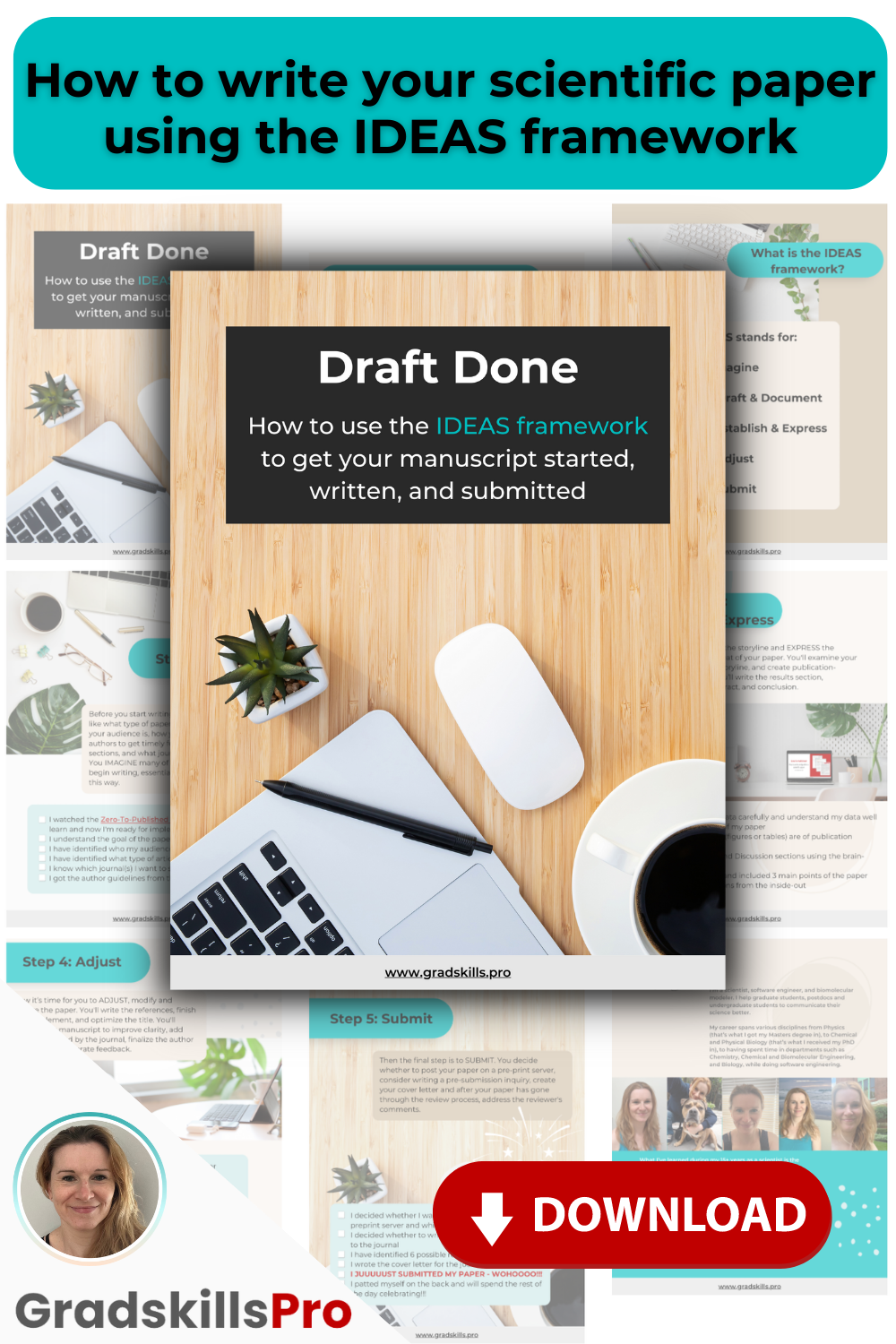
I've been using the IDEAS framework for the last 17 years to write and publish my own papers and I've taught many grad students, undergraduates and postdocs to do the same. All without the stress, writer’s block, endless iterations, or numerous rejections. If you'd like your checklist, click HERE.
Step 2: Start with a simple title
The title is (obviously) the first thing on the page when you start writing your paper. The problem is that most people starting out on their writing journey overthink it waaaayyy too much, leading to writer’s block. Realistically, the title at this point doesn't matter.
Do yourself a favor and just write something down, write down ANY title that you think fits somewhat and then move on. We will revisit the title later on and optimize it, which makes this a lot easier because you know exactly what the paper is going to be about.
Step 3: Write down a preliminary author list
the question you have to answer is, who has helped you with anything? Who has contributed any ideas? Who has done any experiments for you? Who has done anything on this paper for you and who warrants authorship on this?
And these could be lab mates, collaborators, supervisors, your collaborator's supervisor or people who have brought in funding. These could all be co-authors on the paper and they should be considered so that you're not stepping on anybody's toes, and they don't feel left out if they have done something for your paper.
Step 4: Understanding the basics of writing style will save you many iterations of edits later
That's something that a lot of people are doing things a little bit wrong, and especially when they’re just starting out.
The thought that a lot of students have is: "oh, I'm just starting out, so I have to prove myself as a scientist. So, I'm just going to write really long, windy, and complicated sentences with a lot of complex words. That makes me sound smart, therefore, people will actually acknowledge me as a scientist."
And that's a fallacy because often, the opposite is true. The simpler the writing style is, the more people you can reach with your paper because it's understandable. And I always like to quote Leonardo DaVinci here because he said
"Simplicity is the ultimate sophistication" ~ Leonardo Da Vinci
This holds true for many things in science, in research and in scientific communication, including writing papers.

To download your checklist on how you can write scientific publications without writer’s block, anxiety, and major edits in no time, click HERE.
As for the writing style, use simple language and clear writing style with short sentences. Don't make sentences very long - keep them short.
Your writing should follow either the logic or a timeline in the sections and in the sentences
Your sections should follow either specific logic or a timeline in which order you did certain things or your experiments. And also on the sentence level, it should make sense from a logical perspective. It's not good to say “oh, X happened before we did Y, because in that case, the timeline would be reversed and it's more difficult to read.
Our brain always thinks in terms of timelines and logic and therefore you need to write it this way for your audience to be able to understand it.
Use passive voice in the majority of your paper
I always recommend using the active voice in about 10 to 20% of the paper and use the passive voice in the rest. An example is
active voice: "we express the protein"
passive voice: "the protein was expressed"
And I always recommend using active voice only in a fraction of the paper because you don't want to sound like you have an ego problem. If you're always saying things like “we did this, we did this, I did this, etc.” It really sounds very self-centered and you want to avoid that.
On the other hand, if you would only use passive voice, in your paper, it would sound incredibly dry and boring. You want to break it up a little bit. I usually recommend using active voice in the Methods section where it's pretty clear what you did.
Step 5: Write the Methods section using the brain-dump method
I always recommend writing the methods section using the brain-dump method. You're probably going to ask what the brain dump method is. I'm going to be teaching you this in the Zero-To-Published Program.
But in a nutshell: before you start writing the methods section, you're going to create a heading for each section in the Methods section.
And those headings should be the biggest things that you did or that are relevant. For example, if you’re writing a methods paper, sections could be
we created this database
we built this model
we analyze the model
These would be the headings, and then you would move those sections in a logical order and then fill in the details for these.
Step 6: Don’t forget to talk about your WHY in the introduction
We're also going to write the introduction using the brain dump method. But the first thing in the introduction is actually the problem statement – the WHY.
You have to answer why anybody would be interested in reading your paper. Because these days, nobody's got time for anything, right? The reader wants to know "what's in it for me" before they spend half an hour or longer reading your paper.
After the problem statement, in a few sentences, state the current knowledge in the field, read the relevant literature related to the research that you're presenting, and answer questions related to:
What has previously been done?
What has been found?
What kind of results did people get?
And what were the advantages and disadvantages of their research?
Is there any way you can improve on that or are there any unanswered questions that your research is going to answer?
In the last paragraph in the introduction, you are going to talk about your idea, finding, or method.
This is a very short snippet where you're going to introduce what the rest of the paper is about. in this last paragraph, you’re giving a high-level summary that leads the reader into the gist of the paper later on.
Summary
You can use the IDEAS framework to write your scientific manuscript. In the previous posts I’ve outlined why scientific writing is important and how to beat writer’s block, in this post I’ve described the steps to finally start the writing process, which is a lot easier once you understand some basics about the writing style, and how to write the methods and introduction.
For more details, go check out the Youtube video HERE.
In the next post in this series, you will learn about the 5 core elements that make your paper stand out.
Click here for part 1 / 2 / 3 / 4 / 5 / 6

Get weekly updates right into your inbox

Julia Koehler Leman, PhD
Computational biologist, Software Engineer, and Mentor
Passionate about teaching you about Scientific Communication



CATEGORIES
SOCIAL

SUBSCRIBE